Black and White Illustrations of Hop: A Designer's Pattern Toolkit
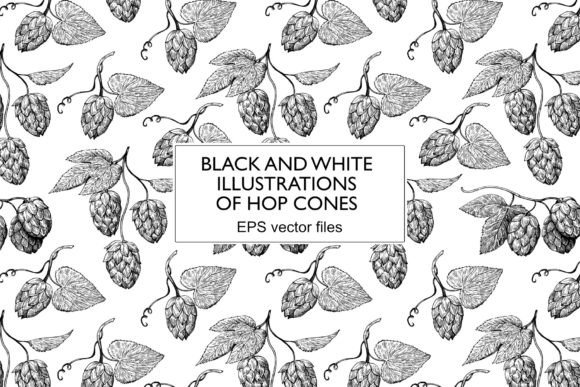
When you're building a brand, a publication, or a product line, the texture is what people remember. It’s the difference between something that feels generic and something that feels curated. I recently came across a set of design assets that captures this perfectly: the Black and White Illustrations of Hop collection. It isn't just a set of drawings; it’s a cohesive toolkit featuring a single EPS file with three isolated vector elements and three distinct seamless patterns, all delivered in high-quality EPS and JPG formats.
The visual style here is strictly monochromatic, relying on an engraved aesthetic. You know the look—fine, parallel lines creating depth and shadow, reminiscent of vintage etchings or old woodblock prints. It gives the work a sense of history and craftsmanship without feeling dated. For a designer working on a craft brewery identity or a boutique packaging design, this specific style bridges the gap between rustic charm and modern minimalism.
The Power of the Engraved Aesthetic in Branding
In a market saturated with flat vector icons and 3D renders, the Black and White Illustrations of Hop offers a distinct personality. The hand-drawn quality introduces a human element that digital perfection often lacks. This is crucial for brand identity. When a customer holds a menu or sees a logo, the texture of the artwork subconsciously communicates the quality of the product. These illustrations suggest that the brand cares about tradition, ingredients, and the "slow" approach to creation.
Because the files are provided as vectors (EPS), you aren't locked into the hop theme alone. You can scale these elements to the size of a billboard or shrink them down for a favicon without losing resolution. This scalability is the hallmark of a premium font or asset library. The isolated elements allow you to deconstruct the imagery. You might use a single hop cone as a standalone icon for a "New Arrival" badge on a website, or you could use the seamless patterns to create a subtle background texture for a business card. The versatility is built-in.
Practical Applications: From Packaging to Web Design
Let’s talk about where these assets actually live in the real world. I see this collection fitting seamlessly into several specific creative workflows:
- Editorial Design: If you are laying out a magazine or a blog post about agriculture, gardening, or craft beverages, these patterns work beautifully as pull-quote backgrounds or chapter headers. They add a layer of sophistication to editorial design that stock photography often misses.
- Packaging Design: For a small business owner launching a new IPA or a hop-infused tea, the seamless patterns are gold. You can tile them across a box sleeve or a label to create a cohesive look that feels high-end. It’s a cost-effective way to achieve that "bespoke" look.
- Digital & Social Media: Content creators often struggle to find consistent visual themes. Using the Black and White Illustrations of Hop as a repeating background on Instagram Stories or Pinterest pins creates immediate visual recognition. The black-and-white palette makes it incredibly easy to overlay text in any brand color.
- Logo Design: While you shouldn't just drop an asset into a logo and call it a day, these elements serve as an incredible starting point or accent. They can act as a framing device or a secondary mark that complements a primary serif font or sans serif font.
Integrating Assets into a Modern Typography Workflow
One of the most common mistakes I see in web design and print is a disconnect between imagery and typography. You might have a beautiful script font or a sharp display font, but if the accompanying illustration feels disjointed, the design falls apart. The Black and White Illustrations of Hop are stylistically neutral enough to pair with almost any typeface, yet they have enough character to stand on their own.
When evaluating how to fit this into your project, consider the concept of visual hierarchy. Because the illustrations are detailed and textured, they naturally attract the eye. If you are designing a landing page, you might use the seamless pattern as a footer background—subtle enough not to distract from the call-to-action, but interesting enough to keep the user scrolling. Conversely, if you are creating a poster, you can make one of the isolated hop cones the hero element, letting the text wrap around it or sit below it.
Strategic Pairing and Contrast
Contrast is your best friend here. The vintage, engraved style of the hop illustrations pairs surprisingly well with ultra-modern, geometric sans-serifs. This contrast creates a dynamic tension that feels current and intentional. Imagine a bold, wide-tracked sans serif font sitting atop a busy, intricate pattern of hops. It balances the organic nature of the plant with the rigid structure of modern typography.
On the other hand, if you want a fully cohesive, vintage vibe, pairing these assets with a classic serif font or a handwritten font can create a warm, inviting atmosphere. This works particularly well for wedding invitations, rustic restaurant menus, or lifestyle blogs. The key is to look at the "noise" level of the illustration. The engravings are detailed, so your typography usually needs a bit of breathing room—larger margins, lighter weights—to ensure readability.
Licensing and Long-Term Value
For the entrepreneurs and small business owners reading this, practicality matters. Always review the commercial font and asset licensing. Most vector assets like this allow for usage in print-on-demand and merchandise, but it’s vital to check the specific terms regarding resale of the raw files. In this case, you are getting a design asset that is ready to use immediately. You don't need to spend hours tracing low-resolution images; the vector work is done for you.
This collection is a prime example of smart asset management. By having the Black and White Illustrations of Hop in your library, you have a flexible solution for a specific aesthetic niche. Whether you are a crafter making stencils, a marketer building a campaign, or a designer fleshing out a brand identity